Friday, February 11, 2011

More on Pakistan's fifth column

I did an earlier post on the fifth column which I urge readers to see. This post covers the same subject but in a little more detail on how they operate. The fifth column of Pakistan promotes self-hatred to such a level that would constitute treason by law in most other countries. Their tactic is to defame Pakistan under the false guise of secularism and freedom of expression.

They try to appear as educated intellectuals and use their celebrity status to try and make people believe their word is the truth when it's a pack of lies especially when they provide no evidence to support it.

Well known examples of these are when most notable fifth columnists such as Pervez Hoodbhoy and Ahmed Rashid accuse the Pakistani government of being behind terrorist attacks in India and training terrorist outfits, they provide not a single specific training location, nor do they mention who exactly is conducting the alleged training exercises.

Ahmed Rashid is a well known book seller and a celebrity in the Western and Indian media due to his Paki-bashing publications. Often he is cited as a source for terrorism having it's roots in Pakistan just as he was cited by Matt Waldman when he created a bogus report on Pakistan training Taliban insurgents by simply repeating claims of Taliban detainees himself. When questioned by a BBC reporter on weather the claims of the Taliban detainees could be trusted, Waldman jumped to cite Ahmed Rashid as if the man's word is unquestionable.

Pervez Hoodbhoy is often considered the ringleader of the fifth column. He has a strange double standard of denying accusations against India being a sponsor in the Baloch insurgency while on the other hand blaming the ISI for being behind terrorist attacks in India without providing any evidence.

It is not just outright lies he promotes against the Pakistani state amongst his other pro-Brahmanist peers, but also implants his false ideas into the minds of Pakistani youth.

Hoodbhoy and the rest of the fifth column also have a tactic of putting on a false sense of persecution as "defenders of truth."
Anyone who tries to challenge them is depicted as a Zaid Hamid loving Islamic fundamentalist who can't accept the truth and is simply brainwashed by state sponsored propaganda.

Though I have not seen it, there are widely circulated claims of a video in which both Pervez Hoodbhoy and Imran Khan are at a talk show and Hoodbhoy is asked by Imran weather he is with or against Pakistan.
Imran tries to expose Hoodbhoy for who he really is which is when Hoodbhoy reacted by accusing Imran of physically assaulting him. This is the kind of false persecution Hoodbhoy often puts on.

There was also another case in which I read of Ayesha Jalal. Ayesha Jalal is another fifth columnist who studied in America and uses her American certification as "proof" of her knowledge of the truth.
She often publishes falsified history of the subcontinent being "partitioned" by the British and is often paraded by the Indian propaganda media against Pakistan.

There was a quote I read somewhere by her of when asked why many other Pakistanis don't study history like her, she claimed that Pakistanis don't like history because they can't accept the truth.

What's recognizable amongst the fifth columnists is that they tend to mix facts with their lies to make their message appear more truthful. Weather it is Pervez Hoodbhoy making brief mentions of Pakistan's overpopulation crisis or Ayesha Jalal pointing out that Pakistan joining America's war in Afghanistan was to avoid isolation as the whole world sided with America right after 9/11.

This makes it only more difficult and confusing for those who are not well read enough in history and politics.

Even more recognizable traits of the fifth column is their constant condemnation of Pakistan's nuclear weapons program and try to depict it as if it was built for nothing. They ravage on and on about the country's nuclear program and make it appear as though demonic. Never once do these people talk about other countries' nuclear programs.

Only when pressured through questioning about why they stay silent on India's nuclear weapons program (which is the main reason behind Pakistan's nuclear weapons program and it's expansion), they claim they are against it, yet never utter a single word of protest against it otherwise the way they protest against Pakistan's nuclear program.

The fifth columnists of Pakistan also try to protect themselves and their reputation by creating human shields of brainwashed Pakistani youth.
With some popularity and 'drones' (people who blindly follow a person or ideology they admire without question) they appear themselves and their opinions to be widely accepted hence any kind of intervention by the government or other is seen as an attempt on suppressing modern thinking and free speech.

Anyone who tries to counter them is projected by their followers as an Islamic fundamentalist. Good examples are the way Ahmed Qureshi and his compatriots have tried to expose Pervez Hoodbhoy and his hive of fifth columnists who use Islamabad University as their base of operations.
But because of Ahmed Qureshi's previous links to Zaid Hamid, he is constantly branded as an ISI agent though I see no evidence of that.

I am also no fan of Imran Khan but his attempt to stand up to the fifth column only highlights his bad reputation by the drones of Pervez Hoodbhoy and others.

Pervez Hoodbhoy tries to appear as some wise old mentor by promoting physics and other science events. This in my view is nothing more than trying to increase his reputation. The fifth column claim they want the best for Pakistan but he (Hoodbhoy) and his fellow fifth columnists have openly stated especially abroad on Pakophobic seminars organized by various anti-Pakistan lobbies that they are against Pakistan and hate their Pakistani citizenship.

Hoodbhoy's drones try to make him appear as some wise inspirational hero very much like Zaid Hamid and his followers.
Anyone who tried to oppose Zaid Hamid before his scandal with the mullahs was suspected of treason.

Hoodbhoy and Zaid Hamid are nothing more than two opposite sides of the same coin. Pervez Hoodbhoy tries to fill Pakistanis with self-hatred and love for the Indian government's policies while Zaid Hamid during his popularity tried to fill Pakistanis with Wahhabi like Pan-Islamist, pro-Arab feelings.

A favorite base of operations for Pakistan's fifth columnists are educational institutions in Punjab which are probably the best in the entire subcontinent. This is where they try to gain an audience and solicitude our most brilliant youth to be their parrots.

Already Islamabad University has been hijacked by the fifth column as a base of operations and has the most known members including Hoodbhoy, Asma Jahangir and other notable fifth columnists who regularly speak there.
This again is very similar to Zaid Hamid and his campaigns to gain followers before his scandal where he'd speak conspiracy theories and spread religious hatred.

It is important for Pakistanis to be aware of their country's fifth column and how they work under the false guise of secularism. On the one hand they claim to be advocates of secularism, on the other hand Asma Jahangir meets with a Hindutva fundamentalist Bal Thackeray who is suspected of being behind the 2002 Gujarat Massacres.

This only harms the idea of secularism in Pakistan and gives a completely false impression of it, only causing people in our country to fear and resent it.

But as I mentioned before, when countering the fifth column and their propaganda, one has to be careful of not turning to Islamist elements such as those of Zaid Hamid's likes. Ahmed Qureshi made that mistake and that may have permanently damaged his reputation.

The truth must be the strongest weapon against liars and traitors, not another group of liars and traitors.

Monday, February 7, 2011

How the Raymond Davis affair is connected to the so-called "new Great Game" in Eurasia and how Pakistan should handle the situation.


Author's note: The reason why I have put some words in quotation marks is because it is referred to as such though some including I see it as a matter of survival for governments and countries. This post may be updated to fill in missing details and/or make corrections.

I want to start this geopolitical post by covering the incident in Lahore and my personal theories on what exactly happened based on all the sources that I have come across.
Though I could be wrong, I believe the entire incident was triggered by a misunderstanding.

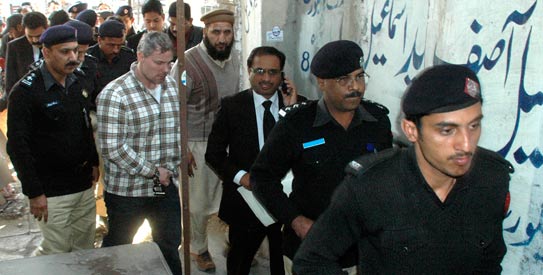
I first thought of Raymond Davis in pictures of his court appearance to be a poor chap caught in the wrong place at the wrong time, but further evidence reported by various news sources make me believe the opposite, that he was on a spy mission. Consider the following points:

-Unconfirmed but various sources claim he could converse in Urdu the national language of Pakistan. Now certain sources claim he lived in Pakhtunkhwa and spoke fluent Pashto as well.

-He carried an unregistered weapon more particularly a 9mm Glock pistol. As uncertain as I am, my understanding is that these type of weapons are not popular in Pakistan. Even though local manufacturers can easily replicate them, local choices are mostly AK-47s and T-T pistols. Even amongst military divisions, this widely American used gun is not popular in Pakistan.

-The autopsies reveal that both men were shot in the back, ruling out the possibility that they were advancing towards him.

-Various sources claim Davis to have military training background and a history of working for the FBI.

-The equipment recovered from his car pictured here included GPS navigation, wireless phone tracking devices, binoculars as well as maps of sensitive bases/installations in Multan, Lahore and others.

-Sources also claim him to have been in Iraq and Afghanistan.


If one is to put these points together, Davis-or whatever his actual name may be-fits the perfect description of an undercover agent.

As many claim, I do believe that Faizan Haider and his brother Fahim were innocent since no criminal records were found on them and the weapon found on them was registered. Faizan and Fahim did indeed go to court with Faizan armed to protect himself from being a targeted witness in a family dispute that killed his brother about a month earlier.

Anyone familiar with Pakistan would know how complicated and dangerous family and tribal feuds can be. Those also familiar with the country would know how life threatening being a witness in a court can be as there have been cases of assignations on court witnesses even right after stepping out of the courtroom.
Police sources claimed that Faizan for this reason had registered his gun for the purpose of self-protection.

I believe when Fahim and Faizan exited the courtroom, Faizan carried his handgun to protect himself from any possible attack. As they left the court he kept his gun in handy in case an attack was waiting to happen.
As they continued their way on the motorbike to the hospital to attend to a relative, their path coincided with Raymond Davis', giving him the impression that they were following him.

At the signal light, Davis discovered Faizan's gun as the two men rode past him in the traffic red light.

When Faizan's gun was showing, it caused Davis, who was behind them, to panic thinking that his suspicion on them following him were correct and that he was about to face a surprise attack.

Upon this Davis opened fired out of the impression that he was defending himself from this surprise attack- and that's when his cover was blown.
From there Davis called for help and the SUV as we all know that came to aid him killed a third person as a result of reckless driving in a bid to save him. Since the vehicle turned back, Davis attempted to flee the scene which according to sources is standard operating procedure for American embassy and consulate employees in case of problems.

This is my perception of what happened in Lahore. But then there are many important questions to follow regarding Raymond Davis and the nature of this incident.

Most importantly where did Davis get the gun he shot the two men with? It was not registered according to local authorities nor is it a popular weapon of choice in Pakistan to my knowledge. So how exactly did he bring it into the country? Surely not through the airport where he'd be caught by security officials.

Thinking of this question brought back to my mind a specific incident described in these reports of armed foreigners; particularly Westerners carrying weapons which are also not popular choices in Pakistan as per their models.

One of those reports describes an incident in which Americans carrying M-4 machine guns and 9 MM Glock pistols- very similar to the type used by Davis. Again these weapons are not commonly manufactured nor often used in Pakistan perhaps due to copyright issues under international law or them being expensive weapons not affordable to most customers in a poor third world country.

That incident is just like the one we saw in Lahore of Americans mysteriously bringing weapons through the borders of Pakistan going undetected.
But the most notable incident amongst those reports which my attention was brought back to is of Americans caught by police in Pakhtunkhwa carrying M-4 rifles which also makes a brief mention of an Afghan national accompanying them without a visa.

To me this makes the answer quite clear. That the Americans are secretly transporting their weapons across the border from their bases in Afghanistan into Pakistan with the help of Afghans.
Smuggling is a well known activity which takes place across the Afghan-Pakistani border. Illegal items from drugs to others are constantly smuggled out of Afghanistan going undetected. This practice has been going on for many decades perhaps even before the Afghan wars began.

Now American weapons for Americans in Pakistan are also being smuggled with the help of Afghans since Pakistan does not issue rights or licenses to foreigners to carry weapons except in extremely rare and special cases.

Why Afghans would help Americans is something Pakistanis have failed to and still fail to understand. Afghanistan has always had an enmity towards Pakistan right from the time of it's independence in 1947. Till present day nothing has changed. It's this enmity that is the root of most political problems in Central Eurasia (I say Eurasia because it involves most of Europe and most of Asia) though I also think Western governments have been trying to take advantage of the situation in order to gain access to Central Asia's rich energy resources.

Pakistanis have failed to understand Afghan hostility towards their country and even fail to even acknowledge it's existence because they are blinded by the curtain of Pan-Islamism and the false belief that Muslims can never hate Muslims.

To understand this enmity and the whole geopolitical turmoil our region today faces, we have to take a look backwards in time.
Afghanistan is a country where tribalism and ethnic ultra-nationalism have always thrived. Most of the violence in the country is much owed to this ethnic and tribal nationalism. Since it's founding in 1747 AD, Afghanistan was ruled by ethnic Pakhtuns who have had a bad history with the other ethnic groups in the country.

Afghanistan's history of ethnic and tribal honor codes seek violence as a means of solving disputes.
Throughout much of it's history, Afghanistan's majority Pakhtuns have managed to keep the non-Pakhtun populations intact mostly through the use of brutal force.

And though there is tension amongst the non-Pakhtun ethnic groups of the country, they have stood united against what they see as a common enemy. At the same time, the ruling Pakhtun elites sought to "reunite" with their fellow ethnic Pakhtuns across the border.

Since Afghanistan has mostly always been under Pakhtun rule, these nationalist Pakhtun leaders tried to use the same force on the Pakistani government as a means of seizing Pakhtunkhwa and Balochistan from Pakistan with their claim of the Durand Line Treaty being invalid as it divides Pakhtuns and Baloch through artificial borders.

These claims are nothing but false and are discussed in detail in this and this article.

Various Afghan regimes weather the royal family or the pro-Soviet communist regimes have sought to take these regions away from Pakistan through force.
However, being militarily inferior, they failed. This only further incited their hatred for Pakistan and their inability to take what they saw as "their lands."

Under the communist regimes, Afghanistan enjoyed military and political ties to the Soviet Union which stood by Afghanistan's false claims over Pakistani territory.
At many times Soviet built planes were used by the Afghan air force to breach into Pakistan's airspace and military confrontations were frequent.

To rid Soviet support to Afghanistan, the Pakistani government sought to topple the communist regime in Kabul via radical Islamist proxies who were already leading uprisings against the communist regime.
The USA saw this as a positive move as it too sought the downfall of pro-Soviet regimes around the world. China also welcomed this move as it had it's own share of historical feuds with the Soviet Union. With the anti-communist uprisings in Afghanistan slowly falling out of control, the communist Afghan regime sought the Soviet Union's military intervention to secure their control over the country.

Reluctantly, the Soviets planned a temporary occupation of Afghanistan with two main objectives:

1) Dispose of Hafizullah Amin the then prime minister who had been enforcing communist practices in the country through the use of brutal force which only gave popularity to anti-government uprisings.
After Amin was disposed of, they planned on installing a new dictator who would be more flexible and keep the country communist through social reforms instead of unpopular, forceful methods.

2) Getting rid of American/Arab/Pakistani backed Islamist rebels who threatened the rule of their communist allies in the country.

In December 1979, the Soviet Union sent it's forces into Afghanistan which is when the whole mess leading to today's political climax began.
The first objective was easily met and Amin was killed, but the second objective was costly and could not be achieved due to the strong support the Afghan Mujahideen received from the West, from Pakistan and the rest of the Muslim world.

Following the Soviet Union's departure in 1989 and even after it's downfall, the situation in Afghanistan intensified. The United States seeing it's objectives in Afghanistan had been met disengaged itself from the politics of that region.

But the instability gave advantages to the other ethnic groups of the country who sought to free themselves of Pakhtun domination. In doing so they forged an alliance best known as the Northern Alliance.
The Northern Alliance composed of ethnic Uzbeks, Tajiks and some Hazaras, received backing from Turkey, Iran, the Russian Federation and India. Fearing that the Northern Alliance was relying on it's arch-rivals for support and slowly turning Afghanistan as their (India, Russian Federation, Iran) proxy state, the Pakistani government sought to support the Pakhtun Taliban who it felt would neutralize the proxies of it's enemies.

The Taliban controlled much of Afghanistan until 2001. Under the Taliban much of the drug production was diminished. Also during this time many militant groups most notably Al-Queda set up bases in Afghanistan. Al-Queda had a history of hitting American installations throughout the world but the Taliban refused to handover their leaders.

Then the 911 attacks occurred. America claims it to be the work of Al-Queda, though I personally feel it was the work of secret elements in the American government and the invasion of Afghanistan was a means of creating a new route to Central Asia's rich oil reserves and getting rid of Al-Queda once and for all.

After the fall of the Soviet Union many oil rich republics in Central Asia sought to export their energy and enhance their economies.
The West also was keen on this and wanted to buy their energy resources, however Central Asia is a landlocked region and all paths leading out of it were blocked by countries hostile to the West. The Russian Federation in the northwest, the Islamic Republic or Iran in the south and Taliban controlled Afghanistan also in the south.
If I'm not mistaken, Pakistan was keen on becoming a transit zone for Central Asian goods and resources to the world since it would be profitable to it's economy.

The West thought of it as a long process and should start soon which is why I feel they are in Afghanistan today.
But their presence has not made things much better for themselves and others except for some stability. The worst part is they have empowered tribalist, ultra-nationalistic Pakhtuns who don't want to share their power with other ethnic groups.

And if things cannot get anymore worse, NATO has tried to forge a government between arch-rival Tajiks and Pakhtuns who do not want to work together and are fighting each other for dominance. Across Afghanistan ethnic violence between Pakhtuns and non-Pakhtuns is still occurring, only adding more to the instability of the country and the region.

The current NATO occupation has only put most things back on square one and that is semi-literate, tribalist Pakhtuns are back in power and only have the same objective: Take Balochistan and Pakhtunkhwa away from Pakistan.

This is not to suggest that Tajiks are anymore favorable to Pakistan than much of the Pakhtun population. The Tajiks despise Pakistan and the Pakhtuns whom they see as Pakistan's puppets. Additionally the Tajiks maintain good cultural, linguistic and political ties with the Shia regime in Iran which too is hostile towards Sunni majority Pakistan. The Pakhtuns despise the Tajiks as they see them as "foreigners" in Afghanistan and they despise Pakistan for holding on to what they see as "their lands."

Weather the royal family or the communists up till the present Afghan regimes, each one has had the prime objective of controlling Pakhtunkhwa (then known as NWFP) and Balochistan.

So how does this all connect to Raymond Davis and the incident in Lahore? Going back through my post, I mentioned Afghans helping Americans smuggle their weapons into Pakistan and help them in their covert spy missions because they are hostile towards Pakistan and see it as an enemy illegally occupying "their lands."

Americans are sending their citizens for both security and covert operations. Various reports claim American "diplomats" in sensitive areas of Pakistan. The West fears that the rising instability in the region makes Pakistan's nuclear weapons a threat to international security.
In this post, I covered the false media hysteria behind Pakistan's nuclear weapons falling into the hands of extremists. I also stressed in this post that Pakistan should not sign any nuclear disarmament treaties that would make it a hostage to foreign aggression.


The prime objective must be to gain maximum knowledge on the country's nuclear arsenal and the Afghans would be more than happy to help. Creating problems for Pakistan has been the main objective for every Afghan government.

What Pakistan can do to deal with the situation:
-In regards to armed foreigners in the country, Pakistan needs to step up it's case to NATO that it will not tolerate foreigners carrying illegal weapons on it's soil.
Right after the Lahore incident, the government should have summoned the ambassador in Islamabad and lodged a public protest as it did in 2008 when NATO troops illegally crossed into Pakistan.

Additionally, Pakistan needs to impose a ban on foreigners moving in between cities on the ground. The movement of foreign nationals through sparsely populated provincial areas will make their activities and movements difficult to monitor.
All domestic movement in between cities by foreign nationals should be by local airlines.

Currently the US embassy does use Beechcraft type planes for transporting their staff within Pakistan. These Beechcraft series planes seen here are marked in the same livery as the two famous American presidential transport Boeing 747-200s which are famously known for their call sign Air Force One. What are the chances of transporting spies and illegal items on those Beechcraft planes? This is why I think they should be restricted to flying on local airlines. If they fear flying with normal passengers due to anti-American sentiment in Pakistan, then they should charter their flights.

By imposing such a restriction on domestic movement by foreigners, the Pakistani government and military should issue strict warnings of legal consequences for those who fail to comply.

The Vienna conventions do not permit foreigners, diplomats or others, to violate the laws of the host country therefore it's important to stress that foreigners be barred from breaking traffic laws and carrying illegal weapons.

Should diplomats and other embassy employees fail to comply with Pakistan's weapons restrictions, the rangers should be made to create blockades around diplomatic enclaves and ensure anyone exiting is not armed or carrying any suspicious items.

Any foreigner exiting the enclaves should be made to identify themselves and the purpose of their movements.
Such restrictions should not be difficult for the Western governments to comply with.

Recently Poland came up with a new referendum making espionage a crime in the country by foreigners. Pakistan needs to pass on the same referendum and adopt capital punishment for spies weather locals or foreigners. Pakistan is also not a signatory to treaties in the Vienna conventions that conflict with domestic laws. So weather a spy comes disguised as a diplomat, he/she should not be liable to expulsion but civil prosecution once a referendum making spying on the state a punishable crime is legalized.

Also the Pakistani people need to pledge their support to the government on this stance if they believe in preventing such incidents from happening again. Simply hounding and blaming the government doesn't work and showing some support at this stage for prosecuting Davis would be useful.

-Regarding Afghanistan and it's constant meddling in Pakistan, the Pakistani government needs to ensure the Durand Line treaty is not violated or any false claims be made on it. The Pakistani government needs to clarify this issue and must do so at the next UN submit in order to silence these false claims coming out of Kabul.

Once it's clarified, any further falsified claims on Pakistani territory should be brought forward to NATO and the UN as a complaint and those in the Afghan government making these claims should be held accountable for trying to break international law and violate internationally recognized borders.

To ensure peace and stability in Afghanistan, NATO needs to put in a multi-ethnic government in Afghanistan (see my world issues and politics blog) and Pakistan needs to support such a move to prevent Afghanistan from again becoming a proxy war theater.

Furthermore; Pakistan needs to take a tougher stance against Afghanistan for trying to create problems weather through helping Western agencies or fueling the rebellion in Balochistan.

This has been going on ever since 1947 and temporarily stopped during the Afghan civil war.
As a start Pakistan needs to send back all Afghan refugees and seal the border to prevent a further wave of refugees from coming. Even those Afghans residing in other parts of Pakistan need to be sent back. Pakistan should also seal Afghanistan's access to the outside world should it's citizens continue creating problems as they are by helping foreign agencies and further inciting the insurgency in Balochistan.

Any military incursion by tribalists or the Afghan military should be dealt with a harsh response.

I explained in this post, the presence of armed foreigners; especially private security agencies outside of embassy grounds is somewhat exaggerated. Of course it doesn't mean that I rule it out completely as Raymond Davis is proof of that. There are also many reports of armed diplomats interrogating locals at gunpoint in the links; hence it's important to enforce our policy of banning firearms to foreigners.

-Also there is a lot of media hysteria in America against Pakistan and vice versa. The American media is filled with conspiracies against Pakistan's ISI for "secretly supporting terrorists" while the Pakistani media is filled with conspiracy theories of the same nature. That America is supporting terrorism inside the region to destabilize it.

I think it's important that the Pakistani foreign ministry and people to take up the issue of false media hysteria and try to defuse it on both sides.

In the end Raymond Davis, innocent or not should be given a fair trial. Everyone even murders must be given a chance to be judged.
It's important to note that Davis was found with spy equipment and by now there is little doubt he is a spy, so those Pakistanis who call for his execution should reconsider that they are asking to kill a valuable prisoner with useful information and who may be the key to thwarting a foreign spy network(s) in the country.

There is also the problem of pro-Western ultra-liberal leftist fifth columnists mainly from the Muhajir community who are as usual defending Raymond Davis and America's reckless policies in the region. The liberal upper class Muhajir fifth columnists always have everything negative to express against Pakistan.

It's important the lies of these liberal lynch mobs be exposed before they mislead the educated elite class of Pakistan who are prone to such self-hating ideas towards their country.

Also important is that the government should ask the people weather they are willing to release Davis in exchange for aid or are willing to sacrifice aid in return for justice. Because currently the people as usual are blaming the government of submitting to American pressure instead of accepting reality that the Americans are cutting off aid due to Davis's detention; hence the people have to choose between one or the other.

The Pakistani government has no control over America's decision to cut aid so the choice must be with the people to keep and punish Davis, release him in exchange for continuing aid, or to come up with an alternate solution weather cutting support to NATO in Afghanistan or some other.

Post update: I found the following by an anonymous person regarding the SUV that hit and killed Ibadur Rehman which should interest readers. Note: This does not necessarily represent my opinions on the issue:

Dear All,

Someone I happened to meet raised a point about the other vehicle (the SUV)
which killed a motorcyclist and is said to have been coming to the rescue of
Raymond Davis. This person said that RD and the SUV were traveling
together when they realized that they were being followed by the two men
killed by RD. The SUV was the crucial one because it was carrying sensitive
material and RD enacted this drama to divert public attention. He succeeded
because the SUV got away to the extent that the people riding it could even
leave the country on the sly while RD has grabbed all attention. Who were
they and what was their mission? The timing when the SUV made its appearance
betrays that the claim that it was a rescue vehicle is ytash and meant to
mislead the media.

Does anyone know more about the SUV and its travelers?

Monday, December 13, 2010

Israel-Pakistan relations: How they are and how they should be.


The relations between these two countries since their independence have been mostly uneasy.
This has been mostly due to Pakistan's reckless pro-Arab/Iranian policy in Middle East affairs.

As I've mentioned in my other posts, I am no advocate of Israeli policies and have opposed the creation of a state like Israel especially in a sensitive area like the holy land which is sacred to Christians and Muslims alongside the Jews.

It is also in my belief that the ongoing Israeli-Arab hostility has only fueled anti-Jewish prejudice around the world, not decreased this feeling which was at it's peak in the Second World War.

Regardless of all that, Pakistan cannot afford an enemy like Israel. Thankfully unlike India, Israel has mostly kept a silent stance towards Pakistan instead of a war mongering blame game propaganda campaign.

There are instances of Jewish lobbies in North America publishing anti-Pakistan propaganda in books and articles, however it is nothing in comparison to the amount the Indian lobbies and media publish on a daily basis.

And even the minor bit of Israeli assistance towards India is all due to Pakistanis entering other peoples conflicts unnecessarily. If Pakistanis were not cursing the Jews and wishing them death the way Hitler did, I can almost guarantee today Israel would stay as far out of the Indo-Pakistani conflicts as much as possible.

Pakistan has literally cut off all trade and diplomatic relations with Israel and has tried not to miss any opportunity to please the Arab and Iranian regimes.
On the other hand we have not been given the same courtesy by them.

They maintain full relations with India both trade and diplomatic. Even during the Indo-Pakistan conflict, Arab pilots were only allowed to patrol Pakistani airspace to protect the country but were prohibited from engaging in direct conflict with India by their governments.

Pakistani pilots on the other hand voluntarily risked their lives to fight for the Arabs and were not restricted. Thankfully we did not loose any of them, however there was always the risk and had we lost them, we would not have had them in times of need.

This is putting the interests of Middle Eastern countries at the expense of our own. Pakistanis think they are doing a favor to the Palestinians and Arabs by engaging in conflicts with Israel when we are only hurting ourselves.

The best way to support the Palestinians is to vote in support of UN resolutions that pledges for a fair deal(s) for the Palestinian people. Other forms of condemnation will only hit back at us and encourage Israelis and Jews around the world to show more support for India in Kashmir.

To my knowledge Israel never took part in any Indo-Pakistani conflicts. But all that is changing with Israel selling India military technology and training Indian troops in Kashmir.

There have also been cases of Israel trying to sabotage Pakistan's nuclear program and probably still are, it is again most likely due to our pro-Arab/Iranian insanity.

I can almost guarantee Israel would never have tried to strike at Pakistan's nuclear facilities or sabotage our nuclear program had we been careful when dealing with Israeli-Arab issues.

Pakistan's nuclear program is only because of India's. Israel knew this and so does the rest of the world. Pakistan even proposed to India to sign a treaty several times to create a nuclear free zone in South Asia. This did not happen. But if it did, Pakistan probably would not have nuclear weapons because India would not have them.

I do not advocate opening diplomatic relations or trade relations with Israel due to threats of espionage and because I feel it is too late to build trust between the two countries after decades of conspiring against one another.
Pakistan should instead stay away from Middle East conflicts as we already have enough on our hands.

I discussed the pro-Arab/Iranian attitude of Pakistanis which is mostly due to General Zia Ul-Haq's Wahabbization of Pakistan.

According to a Baloch acquaintance of mine, General Zia wanted to counter the growing Shia Islamic influence of Iran. It is also well known that Zia wanted to counter the growing sphere of Soviet communist influence in Eurasia and the Americans supported this Wahabbization policy because it suited their agenda in the Soviet-Afghan conflict.

But this Wahabbization seems to have backfired for even Sunni Pakistanis live in worship of Iran.
Pakistanis who think of Iran as a brotherly ally are mistaken and don't realize the Shia regime there is actually anti-Pakistan. It's recent attempt to improve relations with Pakistan is to avoid further isolation by enriching it's nuclear program.

Like the Arab states, the Iranian Shia regime takes a neutral stand on Kashmir and has actually maintained better relations with India.

The Shia Iranian regime actually seeks to enhance it's influence in Pakistan through Pakistan's Shia population which is traditionally pro-Iranian.
A lot of the Shia-Sunni violence in Pakistan is due to Saudi and Iranian funding of both sides, creating more and more proxy wars.

Also it is very naive for the brainwashed, Islamitized, Middle Eastern worshiping Pakistanis to support Iran's nuclear program when even Israel's Arab enemies are against it.

Again, I do not advocate opening trade or diplomatic relations with Israel due to the threat of mistrust, conspiracy and espionage on both sides.

What Pakistan needs to do is minimize it's presence in Middle Eastern political affairs and only maintain trade relations with the Arab states.

Also what many readers might not know is that Israel and Pakistan were actually allies during the Cold War to keep out Soviet influence in Eurasia. The Israelis secretly supplied Pakistan with captured Soviet weapons in Lebanon to give to the Afghan Mujahideen in fighting off the Soviets.

It was not Israel that threatened to bomb Pakistan's cities with nuclear weapons, but the Soviet Union under Kruschev's regime. Studying political history will teach Pakistanis to change their attitude towards Israel.

Pakistan's problem is not Israel but the threat of the Indian Brahman elite, the Afghan Mellat, the Shia Iranian regime and to a lesser degree the Wahabbi Saudi government, all which are much closer to Pakistan's borders than Israel.

Instead of focusing on Israel, Pakistan and it's people need to get on top of key pressing issues faced domestically; especially overpopulation which has been behind most of it's other problems.

Saturday, December 11, 2010

The politics of ethnicity and provincialism in Pakistan

I wrote a similar post on ethnic issues in Pakistan. In that post I covered things that advocates of provincial equality do not usually discuss especially in the area of smaller ethnic groups in the provinces of the dominant ethnic groups.

In this post I hope to draw out a clear structural image of how ethnic politics in Pakistan works.

As I grew up, I learned more and more about my country and people and began to fully notice the enmity between Sindhis and Muhajirs also due to the fact that I am of multiple ethnicities myself.

What I also noticed is that both sides also show a contempt for the Pakistani state as much as they show it for one another. In fact they often accuse each other of being the the Pakistani state.

This might sound puzzling to many readers and those unfamiliar with Pakistani ethnic politics. My experience with most upper class elite Muhajirs is usually their regret for immigrating to Pakistan and a passionate love for India and it's people.

They criticize Pakistan day by day accusing Pakistani people of everything from corruption to religious extremism. Many hate Karachi and say they are ashamed of their home city.

What these upper class Muhajirs and others don't realize is they are describing the negativity of their own fellow Muhajirs. As I mentioned in this post the Muhajirs of Pakistan are amongst the most extreme Muslims in the world.

When Muhajir elites complain about Karachi's terrible situation, they do so while ignoring the fact that Karachi has been under their governance over the last sixty years.
So when Muhajirs draw the negative aspects of Pakistan, they are actually describing their own people and the disasters they have brought upon themselves and the rest of the country.

A Nawab who is a close friend of one of my parents claims that he would be millionaire in India had he stayed back. This is despite the fact that the Nawabs were given so much free land in Pakistan at the expense of many Sindhi peasants whom he now accuses of trying to 'steal' it from him.
Also despite that his entire "salary," though incredibly low, comes from the Pakistani taxpayers which has enabled him to survive without having to work ever.

Another rich Muhajir I know via my other parent is also ashamed of Karachi and Pakistan. She hated the in-flight service on PIA and the inefficiency of other Muhajirs- which she like most other Muhajir elites describe as Pakistani people.

And like most Muhajir elites, she also has a respect for India and Indian people. Most of Pakistan's fifth columnists consist of Muhajirs.

This is where the main resentment of the Muhajir elite for Pakistan comes from. They claim they would be better off in India and often denounce the so-called "partition." Why all this when Muhajirs have been given a significant role in Pakistani politics?

They have been given a stronghold over Pakistan's largest port city and a dominant role in the country's politics. They have managed to terrorize Sindhis and other ethnic groups via the MQM (note that many or even most Muhajirs despise the MQM) and live in high wealth and luxury.

My answer lies in their desire for more power and wealth which is denied to them by another entity that stands at the top and that is Pakistan's powerful military which is dominated by Punjabis.

In India, the gap between rich and poor is much higher than in Pakistan. India has the world's largest poor and hungry population in a single country. At the same time India has several billionaires. Pakistan on the other hand has not a single billionaire to my knowledge. And having a smaller population with higher resources, statistically it has a much higher standard of living and a highest income per capita in the subcontinent only behind Sri Lanka.

Many upper class pro-Indian Muhajir fifth columnists often incite us to love and envy India for it's huge economy and billionaires. While trying to fill Pakistanis with envy of not having a high economy they surprisingly don't try to speak the same for advanced countries with small economies such as Iceland or Denmark.

While trying to fill Pakistanis with hatred and contempt for our corrupt military for stealing our country's resources and enhancing their own wealth, these same Muhajir fifth columnist pro-Indian elites try to fill us with admiration of India's billionaires who can hijack society by privatizing everything.

This is trying to make us love and admire another side of the same coin. The reason behind it is the same. While stuck perhaps forever in Pakistan under the Punjabi dominated military that denies them access to ultimate political and financial power, the Muhajirs are feeling missed out on their ethnic brotherin across the border who have more or less complete domination of their society.

Add to that India's much larger and poorer population compared to Pakistan, giving the rich elites even more and more control over their society.

The case of the Sindhis and their relation to the Muhajirs is actually quite similar. The governing structure of Pakistan places the Punjabis at the top through out the country. While Muhajirs despite being above Sindhis and Balochis, still stand below the Punjabi dominated military force.

Muhajir elites in particular strongly resent this structure because it does not put them at the top. Nationalistic Sindhis also despise the structure of the Pakistani state; hence they too feel rebellious against it, more so than Muhajirs.

Sindhis, Balochis and elite Muhajirs are typically the least patriotic citizens of Pakistan.
Middle and lower class Muhajirs are also an interesting case. They are typically religious radicals and often imitate the people of the Middle East. They often spread Arab and Iranian worship under the false guise of religion.

Middle and lower class Muhajirs also typically promote what they see as patriotism towards Pakistan. This patriotism calls for Islam as absolute state religion and Urdu enjoying a higher status over Pakistan's other languages.

The pro-Indianess amongst many Sindhis comes from many causes. One is of course is the enmity of Punjabi rule of the Pakistani state structure that puts them even below the Muhajirs. The other I most recently concluded is also like the Muhajirs the wealth and power that their ethnic brotherin in India enjoy.

Many readers might be unaware but the story of non-Muslim Sindhis particularly Brahmans was a successful one before independence in 1947 and still is in India. Sindhi Brahmans are said to have a leading role in Bollywood, India's film industry.

If I am also not mistaken, the balance of ethnic power in India is different from Pakistan. In India, Punjabis constitute around two percent of the population wheras in Pakistan they are the dominant ethnic group.

The distribution of wealth and power in India is more on the basis of caste than ethnic group. Though closely related and being almost entirely from Northern India, the North Indian elites- including many Muslims- are somewhat ethnically diverse.

Their commonality is being high caste Brahmins and common Indo-Iranic origins.

Because Punjab happens to be the home of Pakistan's military leaders it is the most developed province in most areas, especially infrastructure. This has given the ordinary Punjabi population many benefits that other Pakistani provinces do not enjoy despite Punjab being more overpopulated than the other provinces.

This is the key reason why Punjabis in general appear to me more patriotic to the Pakistani state and usually turn a blind eye to the injustices carried out on the other provinces.

The Punjabi dominated military's political structure is also interesting. Unlike Pakhtun dominated Afghanistan; Pakistan's Punjabi military accepts people of other ethnic groups in it's institution even at the top levels. If a Balochi or a Sindhi or a Muhajir is willing to work on the agenda of the corrupt military establishment, he shall be accepted by them and even be made a leader.

But it is when too many non-Punjabis gain high positions in the military leadership or even the lower levels, it becomes a cause of concern to the Punjabi military elites.

Even the lifestyle of the powerful Punjabi elites is also an interesting and confusing case itself. Upper class and educated Punjabis both from military and non-military families and their children normally don't identify themselves as Punjabis or with Punjabi language and culture.

Instead they regard themselves as simply Pakistanis and speak Urdu as their native language (though Urdu and Punjabi are almost mutually understandable).

The same is not true for Pakistani Punjabis living abroad. From the ones I've met especially born and raised outside of Pakistan have a closer affinity towards their language and culture. In fact some of them have a resentment towards Urdu because they see it as "the Muhajir's language."

There are even small movements amongst Pakistani Punjabi expatriates to replace Urdu as state language with another language(s) such as Farsi and/or Arabic.

Pakhtuns on the other hand are mostly segregationist save for upper class urbanized, educated Pakhtuns.
By segregationist I mean they do not marry outside their ethnic group or even tribe for that matter. When foreigners from other parts of Pakistan or abroad go into Pakhtun areas of Pakistan, they are welcomed as guests, but pressured to make their stay short.

Even in urban cities of Pakistan, the Pakhtun population, especially poor and middle class, keeps to itself.
Religiously speaking, in general Pakhtuns, Muhajirs, Punjabis and Kashmiris are amongst the more religious types, with Muhajirs at the top.

The Kashmiris are mostly religious and patriotic towards Pakistan due to more than half their land being under Indian control.
Besides them, most of Pakistan's Sindhi and Baloch populations do not follow strict practices of Islam.

The people of the Northern Areas such as the Hunza follow moderate Ismaili sects of Islam while the Sindhis and the Baloch also follow peaceful sects of Sufi Islam and are typically non-observant with the exception of holy occasions.

Urbanized Sindhis and Balochis are an exception and can have strict interpretations of Islam.

In the struggle for political power on ethnic lines, usually Sindhis and Balochis group together against Punjabi and Muhajir hegemony. Pakhtuns, Punjabis and Kashmiris usually stand for state ideology- be it Islamic or secular- while there are differences amongst them as well as all the other ethnic groups as well.

For example the increase in the Pakhtun population of Pakistan has led many nationalistic Balochis to worry despite how easy relations between the two ethnic groups has been especially in the face of the Muhajirs.

Sindhis in general also get on well with Balochis and Pakhtuns; however the influx of immigrants from other parts of Pakistan into Sindh also leads to tension between these various ethnicities and the local Sindhis.

The Muhajirs are in the middle of all this. While enjoying a higher status than most Sindhis in their own province and to a smaller degree in Balochistan and enjoying a degree of support form the Punjabi dominated military, their hunger for even more power leads to conflicts between the two with Muhajir elites showing support for India as well as provincial nationalists in toppling the Punjabi dominated military establishment.

Aside from the ethnic tensions the way of life for most upper class elite Pakistanis remains the same. Urdu and English the main languages of the household regardless of which ethnicity.

The religious way of life usually depends on the ethnic group and varies as mentioned above.
Moreover; the politics of ethnicity and provincialism in Pakistan is extremely confusing and often leads people to be confused (it kept me confused for ages) but when the attitudes and political ambitions of each side is drawn out more clearly, it creates a clearer picture and reduces the confusion.

This post does not intend to "explain" the political issues of ethnicity and provincialism in Pakistan but rather create this clearer picture. Ethnic politics in Pakistan is as described in this post but goes deeper and more detailed. This post helps readers more draw out the structure of ethnic politics in the country like putting together the pieces of a puzzle and see the picture more clearly. Hopefully, it has done just that.

Sunday, November 21, 2010

Child labor in Pakistan and third world countries

Growing up in Karachi in the 1990s and attending a Western-style elitist school, we were put out of the realities of our country and made to look at many issues from a Western perspective. Child labor was one of them.

There were a lot of articles and documentaries distributed around my school by students and others along with pictures with messages against child labor. These people live in a dream world. They fail to rationalize on how these poor children's basic needs would be taken care of with them out of work.

Where will they get money to pay for food and drink if they are only at school?
How will they support their families especially if their parents are handicapped/disabled and unable to work themselves?

If adults are in the labor force and work full time in this field, what is the purpose of them wasting their early life at school, when it will not make a difference or be of much use in their career?

I am no advocate of giving children labor jobs where they are required to put too many hours or energy into labor knowing this can be a hazard to their health in the long term. Neither do I advocate unsafe jobs that can cause injuries or even death.

As long as the jobs done by children are simple and painless, I don't see any other solution that will keep them out of poverty.
I've seen children working as household servants or gardening and similar painless jobs.

I know for sure that if I were a poor child in Pakistan I would prefer to work instead of sitting at home wondering if my parent(s)/guardians made enough money to buy us food and drink.
I would prefer to work as a household servant knowing I can pay for my basic needs instead of begging on the streets hoping that someone with generosity will give me enough money.

Opponents of child labor in Pakistan are completely out of touch with the realities of their country and don't seem to offer any solutions on what they see as a key problem in their society.
As our country continues to suffer from an overpopulation crisis we cannot expect the conditions of our people to improve, only worsen.

In other third world countries there are other reasons for child labor such as political instability or poor infrastructure to maintain a decent society. But in the case of Pakistan it is overpopulation.

When there are too many children per household, people have no choice but to work to survive in order to feed all the hungry mouths. Instead of wasting their minds on child labor problems, our elite class needs to come up with solutions to our overpopulation crisis which will solve most of our other problems including child labor which they seem to be so against.

Monday, October 11, 2010

Pakistan's ungrateful and arrogant immigrants

Percentage wise Pakistan might not be a favorite target for immigrants since Pakistan is a third world country itself, but in terms of sheer numbers Pakistan might have more immigrants than all the Scandinavian countries put together.

According to various websites I read online, there are about three million Bangladeshi immigrants, three to four million Afghan refugees in Pakistan. A few million all together from other South Asian countries such as Nepal, Sri Lanka, Burma and others.

The numbers of these immigrants is one alarming thing to start with. For a country like Pakistan that is already overpopulated, the presence of every immigrant makes a difference weather in the consumption of resources or taking up jobs that could have gone to locals instead.

The crime and other illegal activities many of them engage in only adds more to our long list of problems.

Many of these immigrants have an imaginary superiority complex towards Pakistan and it's people which feeds false ideas into the minds of our youth.
These ideas are misleading and damaging for our youth and people. It is often aided by Pakistan's self-haters which have a strong presence in the media.

As an example I was talking on the phone to one of our housekeepers in Pakistan who is Bangladeshi and we discussed the overpopulation crisis faced by Pakistan and the third world and that Bangladesh has managed to slow down it's population explosion.

He proudly proclaimed how much "better" education is in Bangladesh than in Pakistan and occasionally I remember hearing from him how much more advanced Bangladesh is than Pakistan.
I asked him why then Bangladeshi students come to Pakistani universities to study if education in Bangladesh is much better?

Another question I had that I did not ask him was why was he in Pakistan in the first place if Bangladesh is much superior? I have no enmity towards the people of Bangladesh, but those of them think of their country is more advanced than Pakistan should answer why is it so many Bangladeshis smuggle themselves into Pakistan?

Even this housekeeper of mine has paid bribes to Pakistani immigration officials just to retain his Pakistani citizenship and to prevent himself from deportation.
But why? When according to him Bangladesh is a country with better education facilities; should he not be more than happy to live in Bangladesh?

Shouldn't Pakistanis be smuggling themselves into Bangladesh or going to Bangladeshi universities?
It doesn't just end there with Bangladeshis. Afghan immigrants have been another crisis in Pakistan.

Recently I also had a conversation with another Bangladeshi and he seemed terribly proud that his country is not developing nuclear weapons and kept hinting negativity towards Pakistan for enhancing it's nuclear program while emphasizing Bangladesh as a politically more stable country. He just kept trying to project his country as something "superior" to Pakistan.

Afghani hatred towards Pakistan cannot be questioned. Often on Internet blogs, news articles and other forms of media, Afghans don't hesitate to attack Pakistan and it's people.
Many speak of Afghanistan's "greatness" and Pakistan being the scum of the Earth and the cause for all their problems. All of this when there are millions of Afghanis in Pakistan, getting shelter, committing crimes, stealing and monopolizing jobs from locals.

Self-hatred is another disease many Pakistanis suffer from and is often incited by our confusing Muhajir upper class and spread onto everyone else. They teach the rest of Pakistanis to live in admiration for these countries who's citizens come running to Pakistan like beggars and abuse our hospitality.

Even when Bangladesh is the world's most densely populated country or when their people come to immigrate and/or study in Pakistan.
Even when Afghanistan is the world's largest producer and exporter of heroine while Pakistan is one of the world's largest manufacturer and exporter of surgical instruments for hospitals worldwide, including Europe.

Even when these countries don't export anything technologically sophisticated compared to Pakistan such as components for computers or airplanes.
Our self-hating fifth columnists also promote the countries of these immigrants as "shinning paradises" such as Nepal, Bangladesh or India (I am not sure that there are many Indian immigrants in Pakistan) when the condition of these country's citizens are far worse than the average Pakistani citizens.

Despite the negative side, there are also advantages that some immigrants bring with them for hiring over locals.
Amongst the most prosperous immigrants in Pakistan I find are the Sri Lankans and understandably many Pakistani families prefer to hire them as domestic workers over locals.

In my experience Sri Lankans are far better trained for their jobs as domestic workers than locals weather in caring for infants, elderly people or regular house chores.
They are also generally very professional in their jobs as the problem with locals is they take too many holidays when they are very much needed.

Most local domestic workers are from rural areas and usually have little or no experience in working as household servants.

The Sri Lankan immigrants also charge less for their services than local Pakistani domestic workers do.
So understandably immigrants do sometimes have a positive side to them. But despite Sri Lanka having a smaller population and better living standards than Pakistan, it does not change the fact that Pakistan still has better education and technology than Sri Lanka.

After all Sri Lanka and Bangladesh both purchase arms from Pakistan as well as send their students to our universities.

Why is it then our country is a dumping ground for immigrants from all over the region or their students come to study at our institutions or that while they export only agriculture and textile, we export both as well as sophisticated technology?

If these immigrants are so proud of their countries and pity ours, should they even be coming at all to our country?
Pakistanis need to ask if they would trade all what we have achieved since our independence, for what other South Asian countries have?

Should we trade Islamabad's greenery and well paved streets for India's slums and air polluted cities? Or for Afghanistan's rubble littered towns and cities?

Should we trade our successful technologies that we have achieved in computers, aviation, medicine and other sciences for Afghanistan's heroine production and Bacha Bazi?

Should not we Pakistanis be immigrating to the countries of these immigrants instead of them coming to ours?
Pakistan is by all means the most advanced country in South Asia and the fact that we don't appreciate how blessed we are over other countries in our region is one of our weaknesses.

If these immigrants think so highly of their countries and imaginary superiority, they should be moved back to enjoy this imaginary superiority their countries posses.

I too am in immigrant in a foreign country. My parent and I chose to move thinking it would be better, though we now realize our mistake but cannot move back to Pakistan due to difficulties in adjusting to life there.
Living in North America for almost ten years, I have the opinion there are certain things back in Pakistan which are better.

Youth violence in schools in Pakistan are nothing compared to North America in general. Teens don't carry knives and guns to schools in Pakistan.
Young people there are more obedient and respectful to an older authority figure.

People in Pakistan are also much kinder and friendlier. But despite all the positive things of Pakistan, I don't fail to recognize the better things of the country I live in.

I have been a good immigrant and now a good citizen. I have given more than two hundred hours of community service, including collecting donations for helping blind people. Despite that I was only required to serve forty hours to graduate from high school.
I have never broken the law and even helped the police in a crime that I was a witness to.

And I learned to develop more respect for the country I live in through no other than a fellow Pakistani nationalist who lives in the same city as me.
His values have also been to serve and respect the country you live in even if we feel for our beloved country Pakistan and try to help it in anyway we can.

The attitude of our immigrants has sadly been very different and it is time we took action against these immigrants who only add more to our overpopulation crisis and to our long list of problems.

Any step we take against those who despise our country and add to our problems is a step forward for Pakistan.

Wednesday, September 29, 2010

Pakistan cannot and should not accept a new wave of Afghan immigrants.

Over the past few days, I've been reading of reports of the rise in violence and instability in Afghanistan.
More recently are reports of a tearful Hamid Karzai in his worries of Afghan youth leaving the country.

This cannot only indicate an exodus of young people from Afghanistan, but a complete departure of people of all ages from the country. Why would such a mass exodus be simply consisted of young people? Adults are as prone to violence and kidnappings in Afghanistan, particularly elderly people and women.

That being mentioned, the suggestion of an exodus would only mean a new wave of Afghan refugees fleeing to neighboring countries, particularly Pakistan just like in the first Afghan war against the Soviet Union.
In the first war, Pakistan welcomed millions of Afghan refugees and provided shelter for many of them. This was one of it's biggest mistakes.

Pakistan is an extremely poor and overpopulated country to begin with. The massive flow of refugees only contributed to the overpopulation. Then there's the historical contempt many Afghans have had for Pakistan. Even before the outbreak of the first Afghan war, the country was determined to take Pakistan's western provinces away through various methods.

Even after giving shelter and aid to the refugees all Pakistan was given in return was more hatred and contempt. Many Afghan refugees who fled to Western countries and gained good education and descent standards of living, reembarked on their propaganda war against Pakistan.

From Internet forums to social networking websites to video sharing websites the best use they have found amongst many Afghans is promoting hatred towards Pakistan and Pakistani people, particularly Punjabis as they are the largest ethnic group in Pakistan's armed forces and political system.

Even after the fall of the Taliban and the occupation of NATO, Afghanistan had a chance to rebuild.
Instead of calling out for educated Afghan expatriates worldwide to contribute in the rebuilding of the country, the new Afghan government only installed tribal illiterates, religious extremists and others.

Today the ambitions of this new government seems to be nothing more than a repeat of it's previous predecessors: Destroying Pakistan and erasing the Durand Line.
Even instead of tackling key problems Afghanistan faces, many Afghans both in Afghanistan and worldwide are more interested in embarking on a propaganda war against Pakistan and always blaming Pakistan and the ISI for everything that goes wrong in their country.

This is despite the fact that many of them have lived and still live in Pakistan. On the Internet I've encountered many Afghans who bad mouth Pakistan and speak lies against our country.
Many of them weather Pakhtun or Tajik are able to converse in fluent Urdu, obviously due to the fact that they have lived or still live in Pakistan.

When Pakistan accepted the first wave of Afghan refugees, with it Pakistan accepted a rise in crime rates committed by the refugees. Illegal arms and drug trade was also imported with the refugees.
Many jobs and businesses the refugees obtained was only monopolized by them as they hired as many of their own kind as they could instead of giving any opportunity to locals.

Even today Afghans walk into Pakistan to visit relatives as if it's their second country.
Yet all the time Pakistan gets blame from these people for just about everything wrong in their country from corruption in their own government or drug trade.

Even in her book Empires of the Indus, author Alice Albania briefly mentions the bad mouthing Pakistan and it's ISI get from Afghans for just about any problem they face.
It seems clear in her book to even her that the Afghans have cried "wolf" too many times when there is no wolf in sight.

Even despite being the world's largest heroine producer and exporter, Afghanistan still seems to somehow hold Pakistan responsible for the drug trade.
Also despite the fact that under the then Pakistani backed Taliban most of the drug development in Afghanistan was close to extinction.

Today the descendants of many former Afghan refugees in Pakistan now living in Europe, North America and elsewhere spread the lies they learned from their parents on the Internet against Pakistan.

Accepting a new wave of Afghan immigrants would mean accepting an increase in our country's already uncontrolled population growth. It would mean having to face even more of an already increasing problem of illegal arms, drugs, crime and others that a new wave of refugees are likely to bring with them.

It could also mean planting the seeds of a new upcoming Afghan generation who will carry on the propaganda war against Pakistan just as their forefathers did.

Accepting a new wave of Afghan refugees is simply unthinkable. We made one deadly mistake in the past by accepting the first wave of ungrateful refugees who only gave us more problems in return. We should learn from our past mistake and not repeat the same mistake twice.

Instead, Pakistan should take immediate steps to remove all foreign refugees and seal the Pak-Afghan border in advanced preparation to prevent more refugees from coming.

A billboard inside Pakistan posted by Afghan immigrants calling for the integration Pakhtunkhwa and Balochistan to become part of Afghanistan: (click on image to enlarge)